01
Modern production line
The present continuing the legacy. Triangular bars march left to right along the steel conveyor between inspection machines — the craft, now at scale.
This film isn't aimed at a chocolate audience. It's aimed at the everyday Swiss worker — someone with goals, someone who understands that progress is never a straight line. That's the whole idea behind the title: Die Geschichte war nie geradlinig.
Toblerone's own story mirrors theirs — honey, almonds, nougat and a stubborn idea in Bern that became a shape recognised across the world. Not overnight. Not in a straight line. The commercial connects the brand's journey to the viewer's own.
That's the part most brands get wrong. They talk about themselves. Nobody cares. I say that with love — and with the memory of having done it myself. People care about their own crooked path — so I built the film around theirs, and let Toblerone tag along. That's not a copywriting trick. That's brand architecture: deciding who you're actually talking to before deciding what to say.
The German voiceover carries the emotional weight of the piece — quiet, thoughtful, a little wry. Generated in ElevenLabs and directed with performance tags for breath, whisper and warmth, then stripped clean for the final mix.
Manche Geschichten verlaufen geradlinig.
Diese nicht.
In Bern begann eine Idee — aus Honig, Mandeln, Nougat und Schokolade.
Dann kam die Form. Ein Dreieck.
Aus der Schweiz. Erkannt in der ganzen Welt.
Toblerone.
Die Geschichte war nie geradlinig.
Every visual intention was written in model language: push-in vs. zoom, dolly vs. pan, orbital arc vs. rotation. A cinematographer's grammar, encoded so the machine obeys it.
The prompts weren't optimised in theory — they evolved from real generation failures. Each deformation fixed became a rule baked into the template.
Negative blocks ordered by severity. Physical directions locked and explicit. Tempo repeated across camera, action and negatives. Plus a dedicated text-stability block — the most fragile element across every model.
The "AI look" was broken into its tells: plastic surfaces, floaty motion, over-processed HDR, synthetic sheen — and each one banned by name.
The "TOBLERONE" wrapper treated as a rigid label that never deforms, even as the bar tilts.
Geometry, peak count and texture locked. No morphing, no melting, no collapse.
The slow, patient pacing reinforced three times per prompt to beat model drift.
35mm grain, subtle vignette, micro-contrast — every frame had to read as a real cinema camera.
01
The present continuing the legacy. Triangular bars march left to right along the steel conveyor between inspection machines — the craft, now at scale.
02
A worker wheels a steel hand truck stacked with Toblerone cartons toward the cargo truck. Real Swiss factory, real weight, real ground.
03
Cobblestone street at winter dawn. The founder, back to camera, unlocks his confectionery and steps inside. Where an idea began.
04
The invention laid out like sacred evidence: honey, almonds, nougat, chocolate and the handwritten recipe. The raw truth of the product.
05
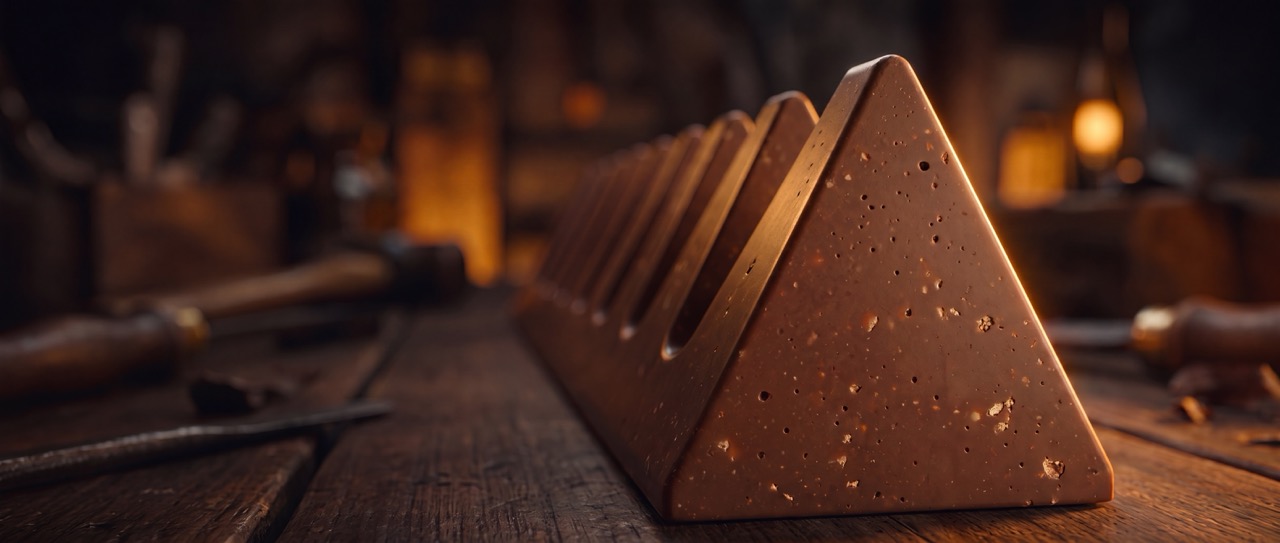
The first iconic triangular form emerges — sculptural, monumental, edible. The shape that the whole world would come to recognize.
06
The Matterhorn — a triangular silhouette that rhymes with the product itself. Swiss identity, permanence, grandeur. No postcard cliché.
07
One gesture, repeated across the world: the hand holds the bar against every city, the Matterhorn printed on the wrapper against every skyline. Switzerland travels with you.
08
The close. Pack and chocolate on a warm surface, logo legible, geometry perfect. A push-in where only the amber light breathes. The last image of the film.
One gesture, repeated across the world: the hand holds the bar against each city, with the Matterhorn printed on the wrapper against every skyline. The same hand and chocolate stay frozen; only the background and light change. The film's thesis, made into a recurring image.
Directed Tarantino-style, shot in 21:9 with 35mm grain, narrated in German through ElevenLabs, built across 9 keyframes. Here's what did the heavy lifting:
Strategy, script, direction, voice, edit — everything on this page came from one desk in Zürich. Not because I think one person should do everything. Because when perception is designed by one point of view, nothing gets lost between departments.
That's what Brand Elevation™ is. If your brand needs that kind of clarity, this is how I work.