Brand Elevation case study
Trust Gut is a fictional Swiss prebiotic soda built to show how a brand can move from market tension to product logic, voice, campaign architecture and AI-directed execution.
The point is not to make another pretty can. The point is to prove how a clear strategic system can make a product feel believable, ownable and ready to enter a conversation.
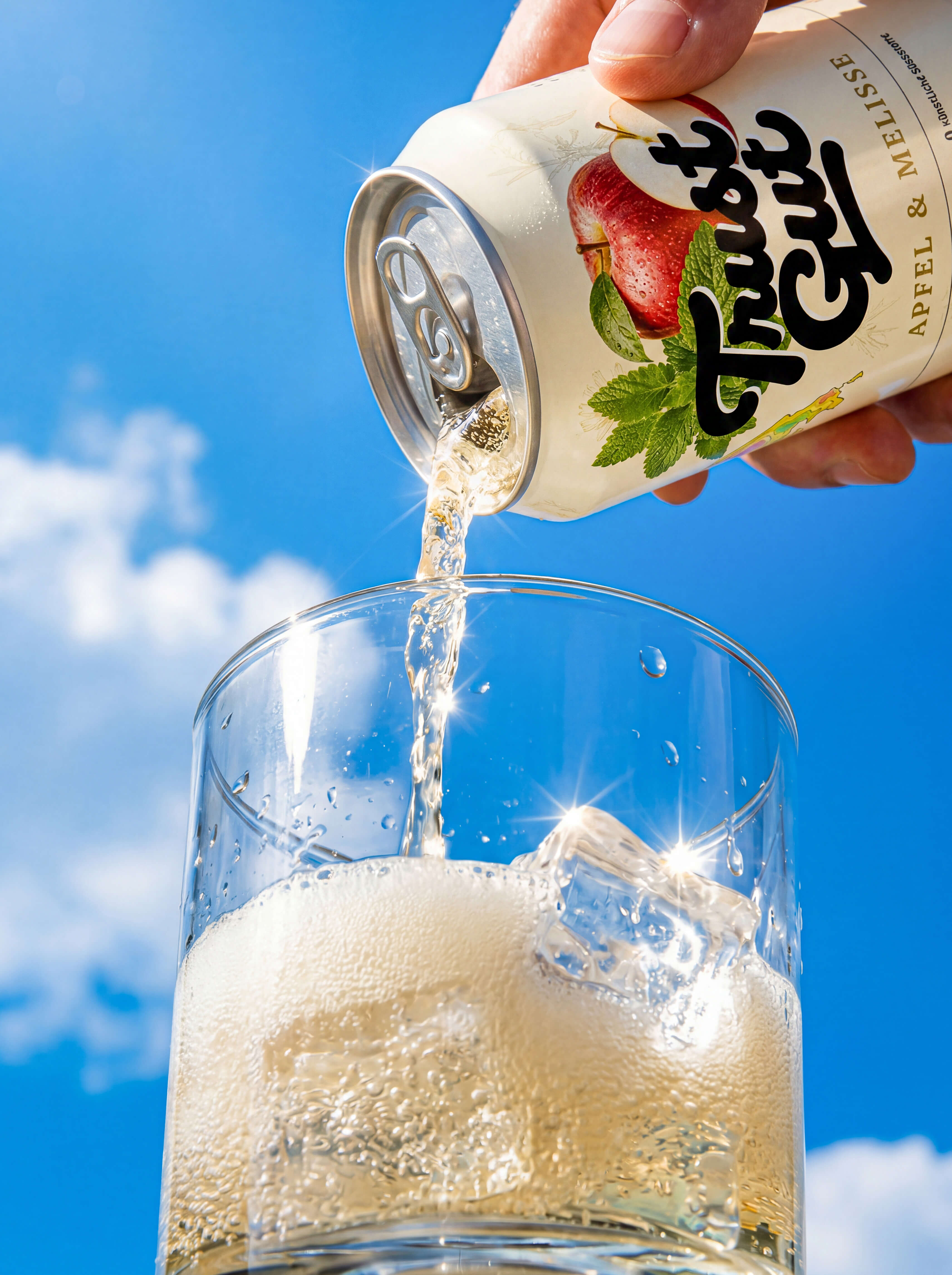

The category logic starts with pressure: people want health without performance theatre, pleasure without guilt, and functional products without fake medical promises.
That tension made prebiotic soda a useful territory to explore: not because it is trendy, but because it sits at the intersection of sugar anxiety, gut-health curiosity and consumer distrust.
Three rounds of research said otherwise, with numbers, not opinions:
Translation: an honest functional product has more reason to exist than a beauty one — not because I like it better, but because the market is screaming for it, with figures. My hunch didn't matter. The data did.
And within functional, there was a gap shaped like a gift:
That's where the vision was born, and it was born whole: proof that you don't have to choose between pleasure and your body. That false choice — enjoy or take care of yourself — is the lie the whole category was built on. TRUST GUT exists to dismantle it.
Notice we still haven't talked about the drink. Or the logo. Or a single photo. We're a whole section in and we've only talked about what's true in the world. That's the right order.
"Everyone" is not an answer. "Everyone" is what you say when you haven't thought hard enough. A brand that talks to everyone talks to no one, and ends up sounding like a bank's press release.
TRUST GUT talks to one person. Her name is Lena.

Why so much detail about a person who doesn't exist? Because every future decision — every word, every photo, every color — will be measured against her. Would Lena laugh at this or roll her eyes? Does this sound like someone who gets her, or like someone trying to sell her something? When you have Lena in your head, the hard decisions become easy. When you don't, everything is opinion, and the loudest opinion wins — usually whoever shouts most.
Lena's golden rule, which governs everything else: she doesn't want to be sold to. She wants to buy from someone who understands her. There's a huge difference between those two things, and almost all advertising in the world lives on the wrong side of it.
Every brand with character needs an enemy. But picking the wrong enemy can sink you.
The easy instinct is to fight a competitor. Coca-Cola, the big brands, the one next to you on the shelf. It's tempting because it's concrete. The problem is it turns you into "one brand fighting another brand" — and in Switzerland that's legally and culturally risky, plus it gives Lena something to defend on the other side. When you attack a company, someone always steps up to defend it.
The smart move is to climb a level of abstraction: from "who" to "what."
TRUST GUT doesn't attack brands. It defends bodies.
Nobody sues you for defending people's gut flora. Everybody dislikes the one defending a corporation.
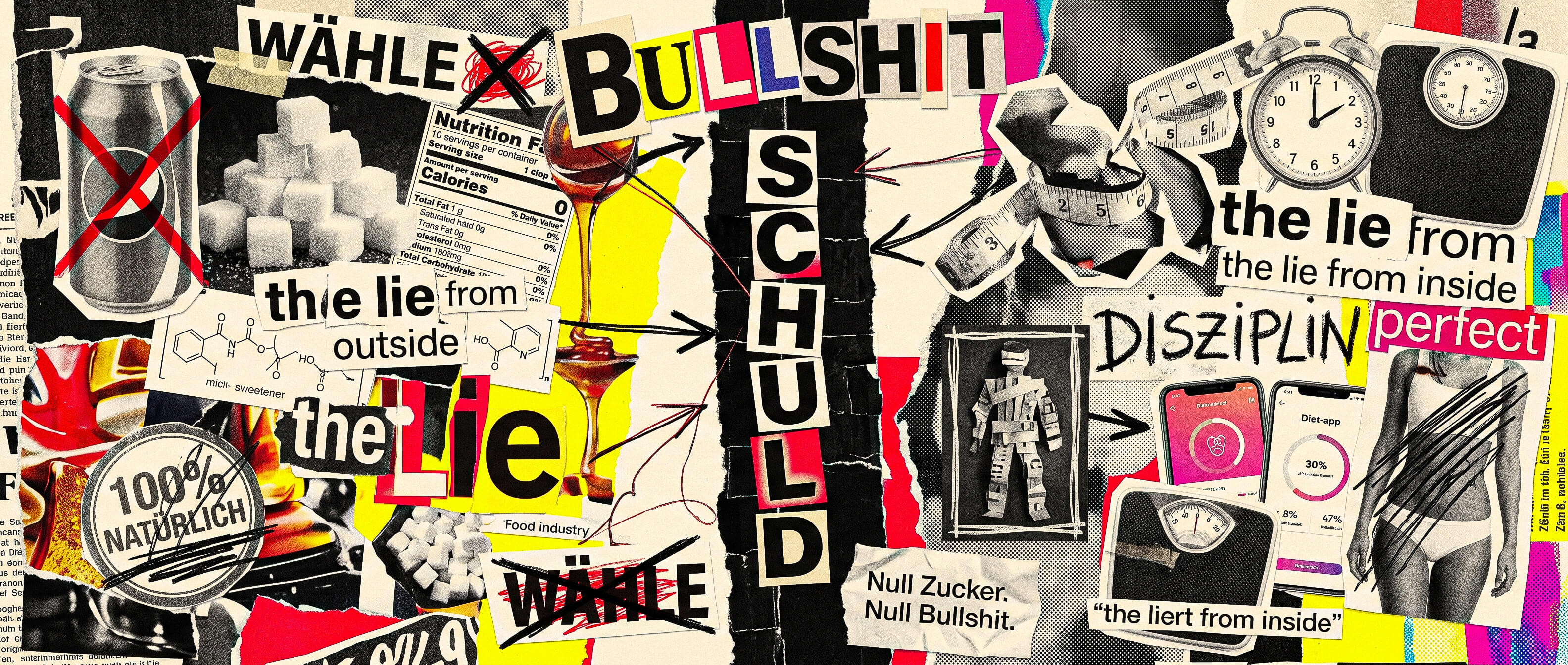
The enemy, then, isn't a company. It's two lies with a single root:
Both lies want exactly the same thing: for Lena to feel guilty. One sells her guilt from outside, the other injects it from within. And guilt, it turns out, is a pretty profitable business model — if you can make someone feel bad, you can sell them the solution forever.
TRUST GUT plants itself right there, between the two lies, and says: the choice between pleasure and body was never real. It was the trick. It was always the trick.
You know what you're fighting against. Now: in what voice? Because you can be right and still sound insufferable. The internet is full of people who are right and whom nobody wants to listen to.
TRUST GUT's archetype is a hybrid, and that's its strength: Outlaw-Sage (Outlaw × Sage).
The crucial thing is what TRUST GUT is not: it's not the pure Outlaw, the one shouting in all caps with energy-drink attitude. Lena would detect that as hot air instantly — because the Outlaw who shouts is the industry she despises. TRUST GUT is an outlaw who doesn't need to shout because the truth is on its side. There's a calm in being right that no amount of caps lock can fake.
And there's a shadow to watch, always. Every Outlaw can turn cynical, superior, and turn "Null Bullshit" into its own brand-that-thinks-it's-smarter-than-you routine. If TRUST GUT loses the 40% of warm Sage, it becomes insufferable: the brand that despises its own consumer. The antidote is a single rule, and it's never broken:
The edge never points at Lena. Always at the lie.
Lena is never the joke. She's the accomplice who already woke up.
There are many ways to stand beside someone. The one chosen — over "the insider" (smells of superiority) and "the dry witness" (cold, builds nothing) — is the friend who already woke up.
It's someone who went through the same thing as Lena. Bought the vitamin water. Tried the stool test. Felt guilty for wanting something sweet. And came out the other side. They don't talk down to you — they talk to you from one step ahead on the same road. The difference is enormous: the insider says "let me tell you how the industry works" (educates you); the friend who woke up says "I fell for that too, not anymore" (walks with you).
Here's the heart of the method, and it's what gives all of this its name. Most campaigns struggle when they try to start a conversation from nothing. It costs attention, time and trust, because the market is already busy with its own questions.
Brand Elevation looks for the conversations that already have their own energy and gives the brand a precise way to enter them. Trust Gut does not force relevance; it earns it by speaking to a tension people already feel.
Four live conversations were mapped, all sharing the same root (trust your gut):
The question was never "what do I want to say?" It was "what is Lena already talking about, and how do I enter that conversation in a way that feels like someone finally gets her?" That difference in order is the whole craft.
Only when all of the above was clear — the gap, Lena, the enemy, the voice, the conversations — was the tangible thing built. In that order, never before. But coming last doesn't make it minor: the product is where the stance becomes verifiable truth. An honest brand selling something dishonest is just another lie with better copy. The rule that governed every decision: nothing decorates, everything argues. If an element doesn't defend the value proposition, it goes.
TRUST GUT can't say "trust me" if the can doesn't back it up. That's why the formulation is the soul of the project, not its packaging. It's a prebiotic soda, no added sugar, made of things you can pronounce and trace back to a specific Swiss field.
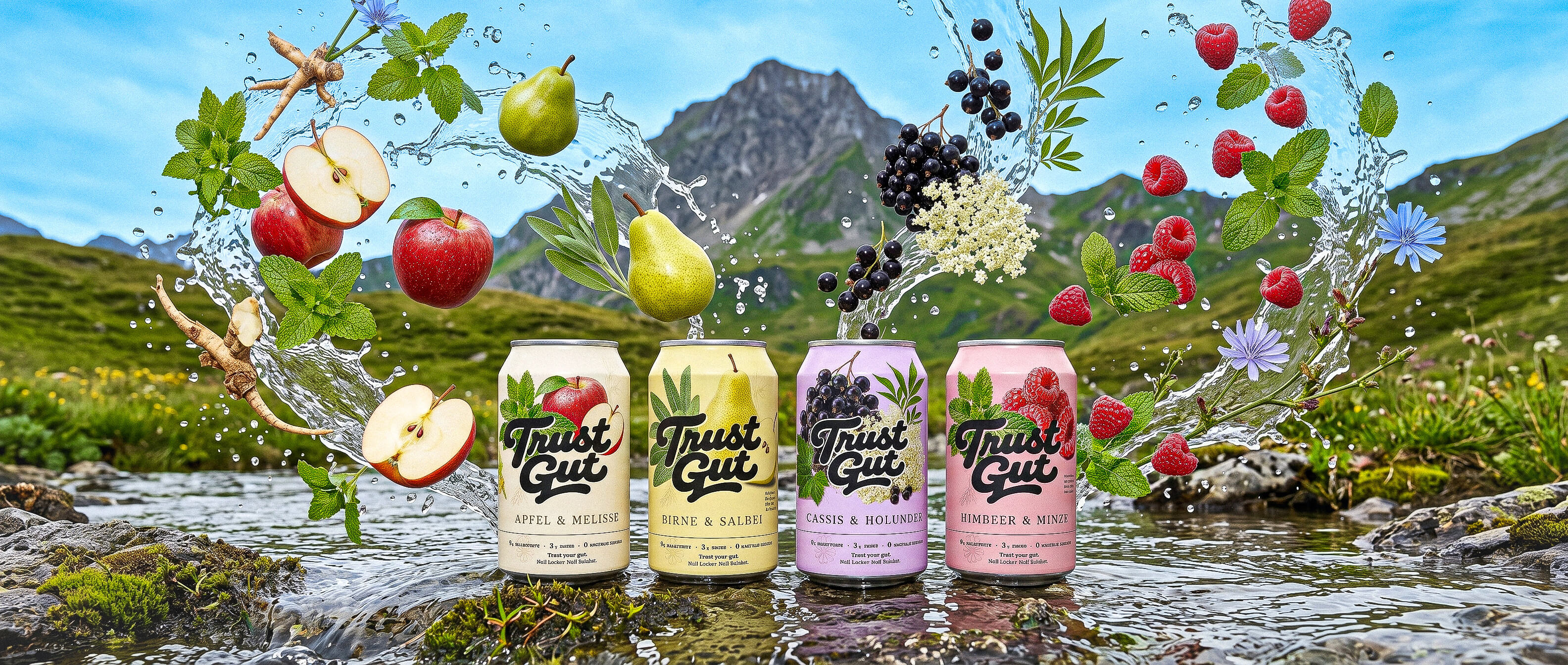
The heart is chicory inulin prebiotic fiber — real fiber, the kind the category pretends to have. On top of that, Swiss Bio Suisse alpine herbs: lemon balm, sage, lavender, mint, elderflower — the Ricola sourcing model, mountain herbs with a name and an origin. And 100% Swiss fruit: Thurgau apples, Williams pears from Valais, raspberries and blackcurrant from Swiss cantons, apricot from Valais. 0 artificial sweeteners. Sweetened with stevia from natural origin. Zero artificial color. Two to three grams of sugar per can.
Concept formula for case-study purposes. Nutritional values, sourcing logic and certification references are strategic design assumptions, not a commercially validated product formulation.
The national angle here isn't patriotic decoration — it's trust infrastructure. In a market where Lena distrusts by default, "abgefüllt in der Schweiz" with the canton of origin printed on the can is a promise that can be audited. You don't ask her to believe: you show her where each ingredient comes from. Traceability is the no-nonsense promise, made product.
Product — spring water, chicory fiber, alpine herbs, 100% Swiss fruit
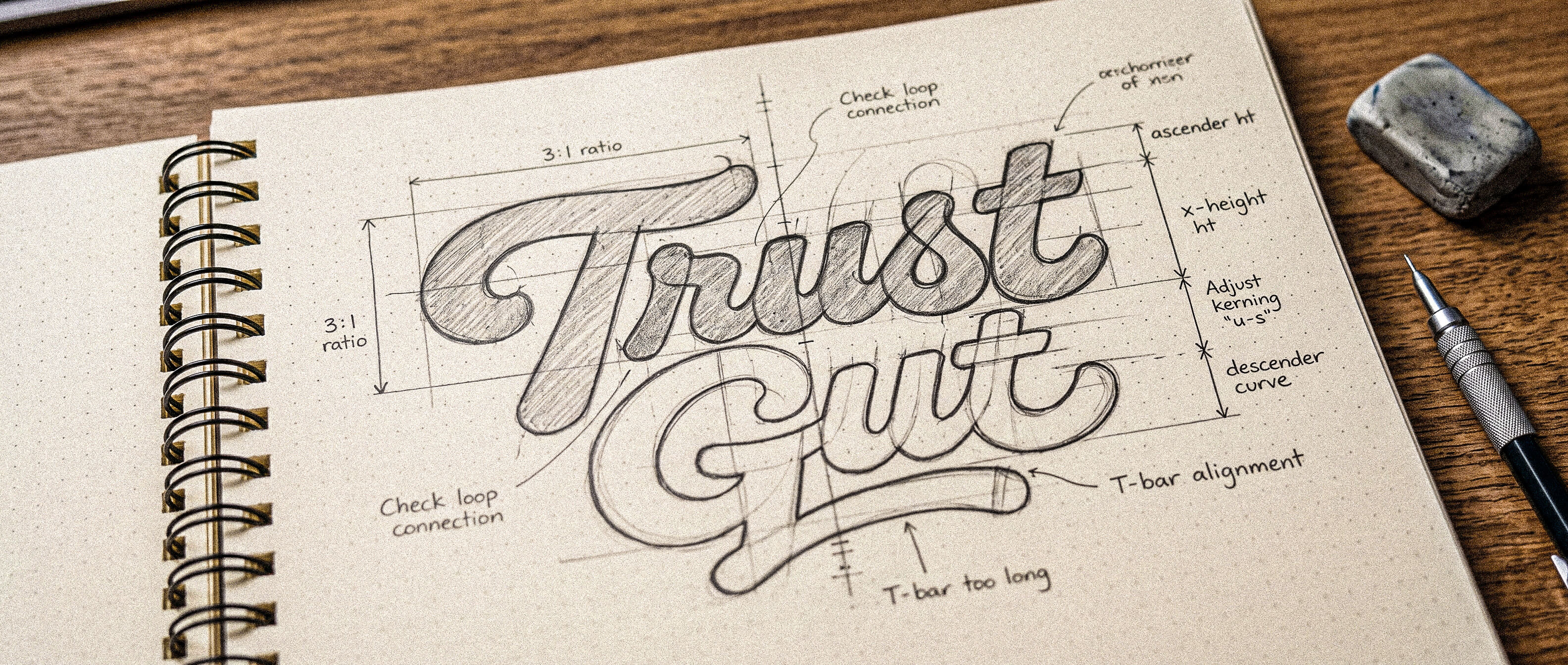
The logo is direct by design. Thick black script, "Trust Gut," high contrast, holding the can's center of gravity with the confidence of a brand that knows what it wants to say. It gives the product presence without turning functional health into clinical language. And it carries the mother double-meaning of the whole brand: trust your gut — trust your instinct, trust your gut, and in German "Gut" also means "good." Three readings in two words.
Logo — the script that plants itself in the center
Every label decision carries an argument, none is ornament. The geometric color blot behind the text isn't abstract: it's the real topographic map of each flavor's canton of origin (Thurgau for apple, Valais for pear). It's cartographic and Swiss — precision and belonging, never the alpine cliché of cows and edelweiss — and it's the burst of color that brings the edge without dirtying the rest.
The visual soul is born from a deliberate collision of two techniques: cutout real photography (the fruit, the herb, with its shadow) which is the tangible, the pleasure, the thing itself without makeup; over flat vector (the canton, the chicory background pattern, the grid) which is Swiss rigor, the system. Photo = honesty and pleasure; vector = order and method. That tension is the identity.
And the nutritional numbers go up front, as heroes, not hidden on the back: 9g fiber · 3g sugar · 0 artificial sweeteners. Sweetened with stevia from natural origin. In a category rotten with dishonest claims, the raw figure is the weapon. We don't say "we're good" — we show the verifiable number and let Lena draw the conclusion. The background is cream, not electric blue: the can competes on the Apfelschorle shelf, not on the energy-drink set. The disruption comes from the art and the voice, never the color.
Label — topographic canton, photo/vector collision, numbers up front


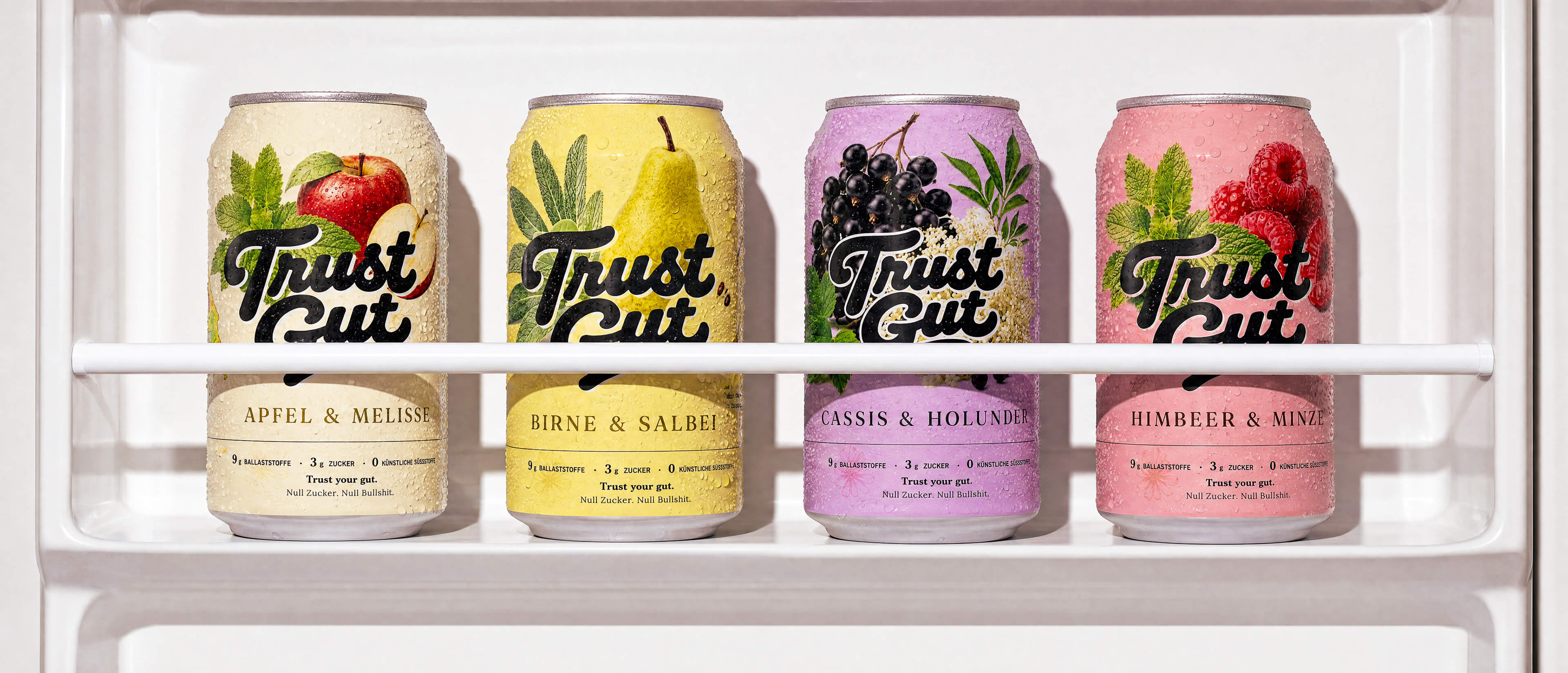
Short 330ml can, stubby format — wide and low, never the slim energy-drink can. The shape is positioning: a short can lives in the world of honest, family soft drinks, not in the world of performance drinks with attitude. Five flavors: four permanent (Apfel & Melisse, Birne & Salbei, Cassis & Holunder, Himbeer & Minze) and one seasonal (Aprikose & Lavendel). Each with its canton, its fruit and its herb — a range that's also a map of Switzerland.
Mockup — the family of short 330ml cans
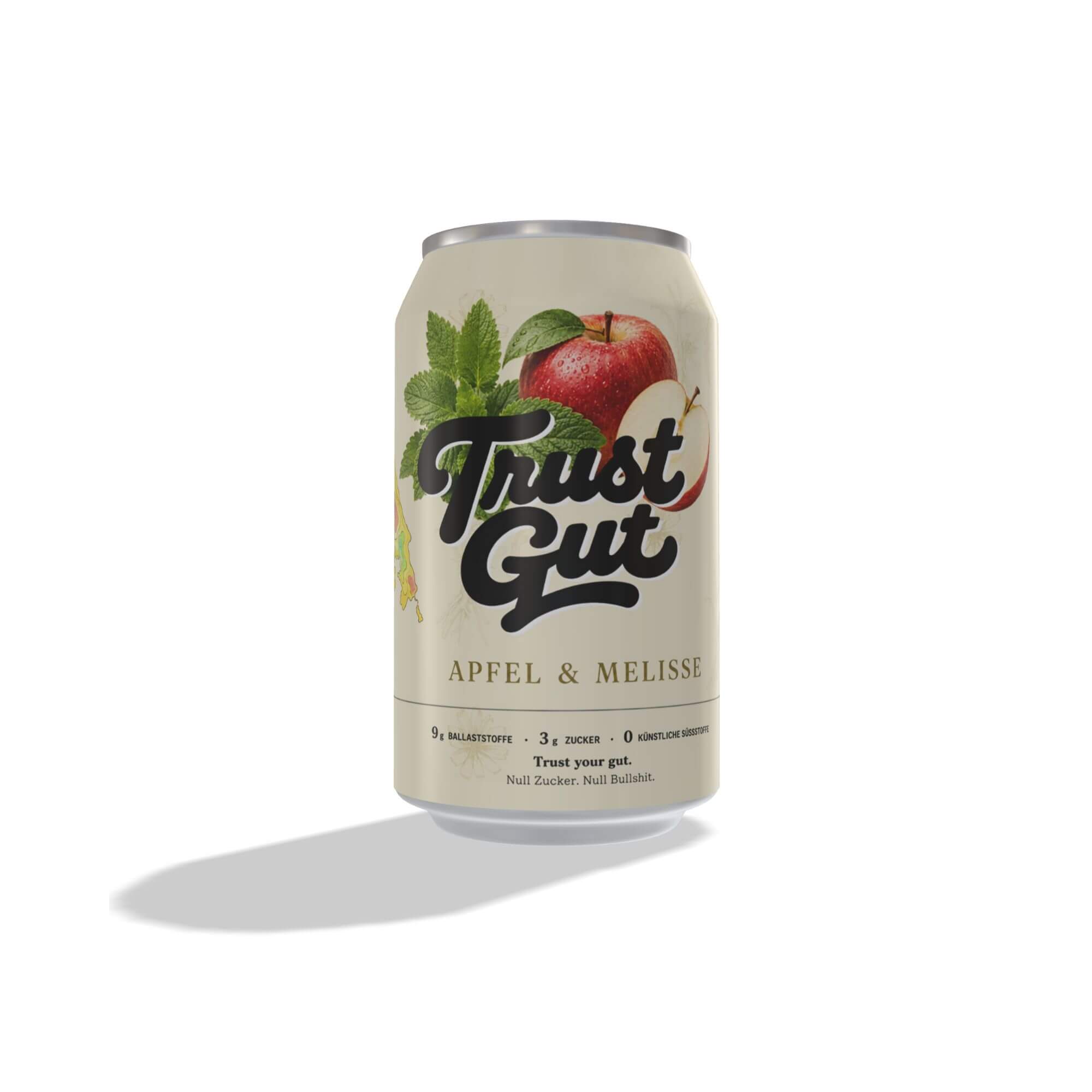
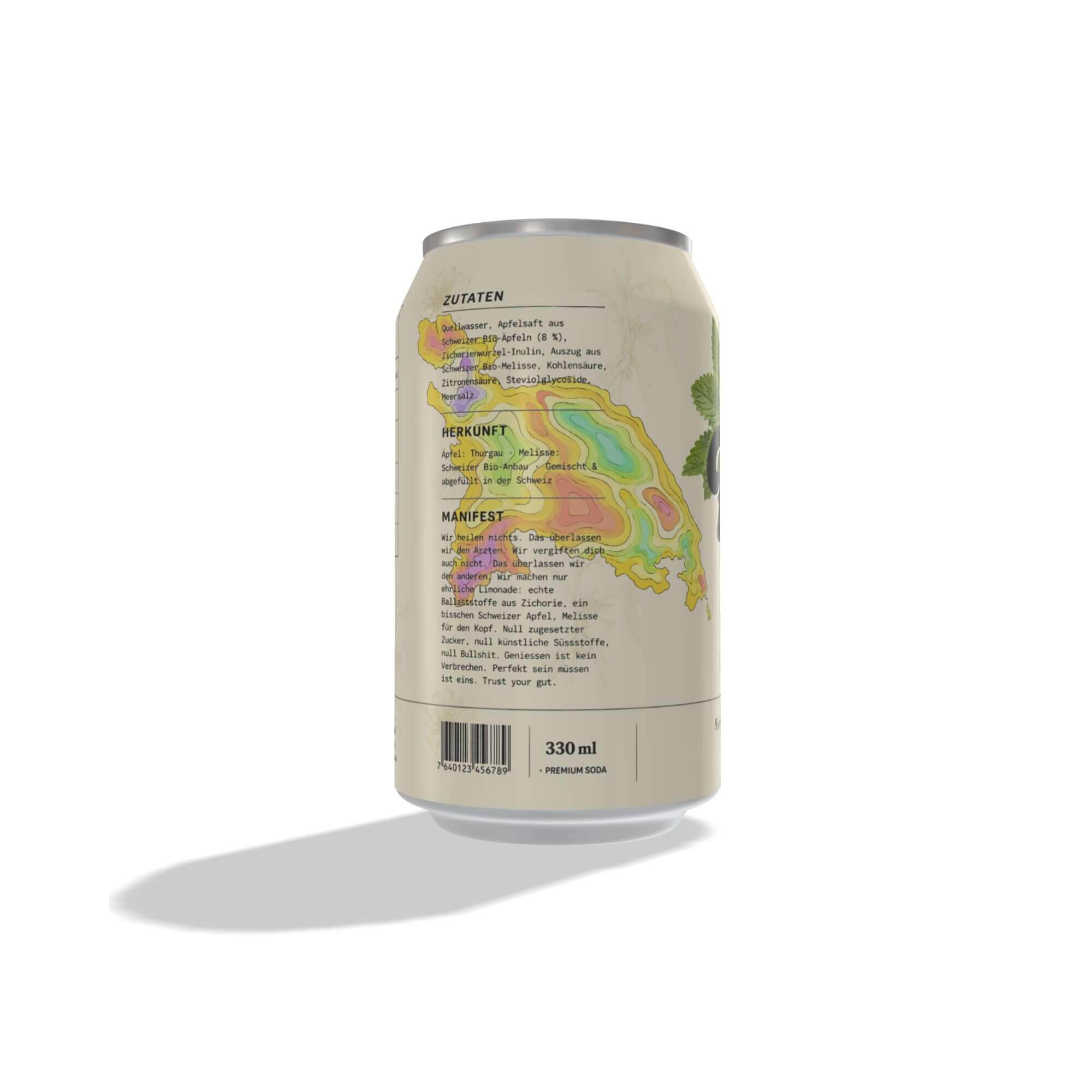
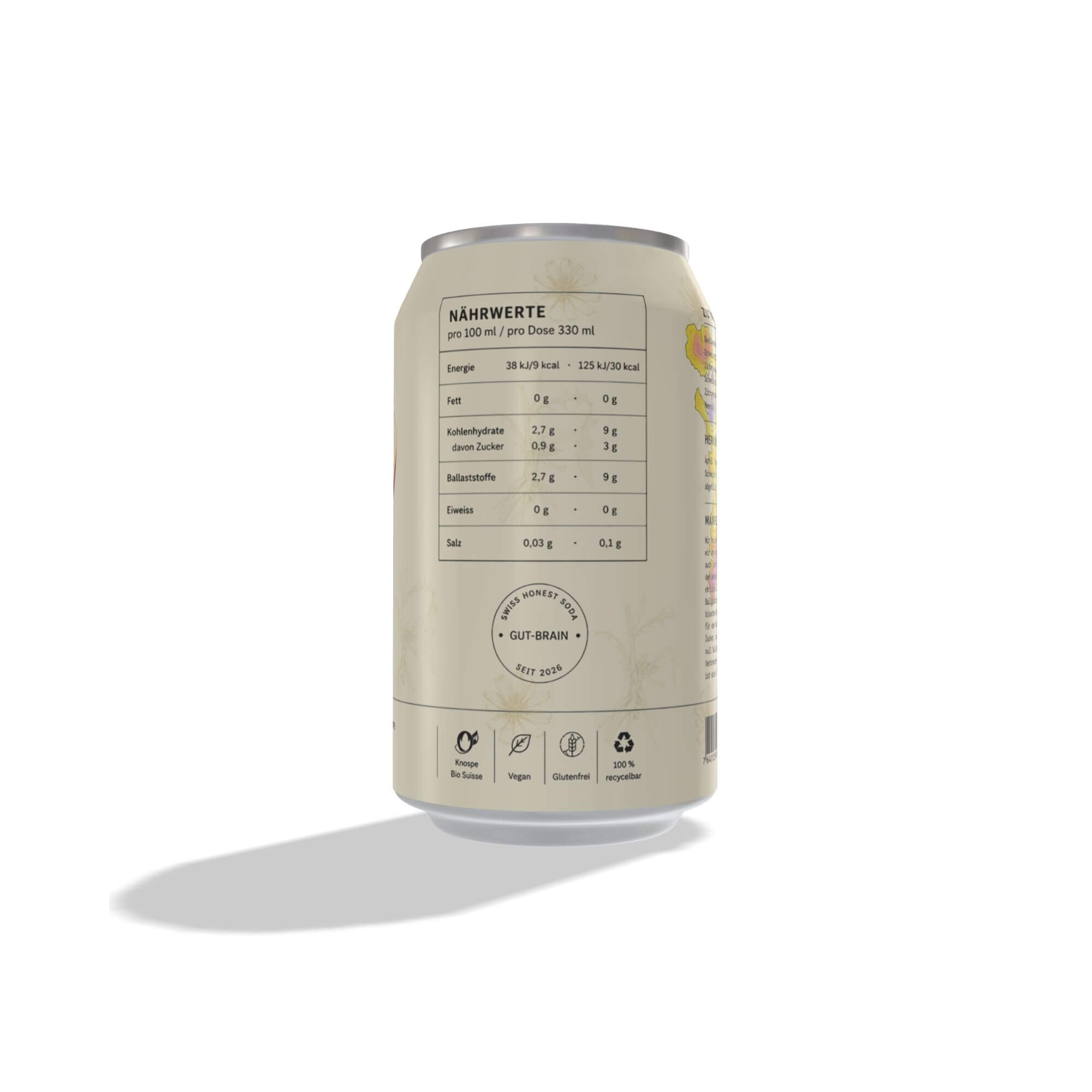
That's the product: not a package with an idea on top, but an idea that became drinkable and traceable. With this in hand, the campaigns stop being advertising and become what they should always have been — conversations.
This is where almost everyone goes wrong again. They produce "content": a pretty photo, another pretty photo, a meme, a line. Isolated pieces that don't talk to each other. The result feels like a drawer of unmatched socks.
A real campaign is a sustained conversation. Each piece says something different about the same truth, and together they build a world you want to step into. For TRUST GUT, three conversations were designed, each entering Lena through a different side of the heart.
And they're not three loose ideas: each campaign is the direct answer to one of the conversations Lena already has in her head. The map is clean on purpose:
Read this way, Campaign C isn't a nice add-on — it's the strategic consequence of closing the loop: first I earn your trust (A), then I free you from guilt (B), and only then do I earn the right to love you (C). Distrust, permission, belonging. That's Lena's complete journey, and each campaign is a station.
Campaign C is where Trust Gut stops acting like a functional drink and starts behaving like emotional infrastructure. It is not about optimization. It is about the small domestic rituals that make Lena feel human again: the couch, the cat, the quiet rebellion of doing nothing for five minutes.
The conversation of the edge. Lena distrusts the industry; the brand plants itself on her side. The line is the protagonist, the data makes the argument. Evidence mechanics: it doesn't argue, it shows the number and goes quiet. Four street posters, one per flavor.
Tagline, in Swiss German: Kei Verspräche, kei falschi Etikette. Nur ehrlichi Schwiizer Limo. (No promises, no false labels. Just honest Swiss soda.)


The warm conversation. Here Lena doesn't need to be convinced she's healthy — she needs to be left in peace. Hard flash over scenes of calm: calm with a backbone, not soft wellness. Lena present with real hands and gestures, not stock; the imperfection is the permission. And a key move: her runner cousin enters, because Lena doesn't trust a brand that only talks to women of her demographic — that smells of a PowerPoint segment. Seeing a real man from her life breaks the suspicion. Diversity not as a quota, but as proof of authenticity.
Signature, call and response: Hör uf dis Bauchgfühl. / Din Buuch dankt's der. (Listen to your gut. / Your belly thanks you.)


The emotional conversation, and the first one closed 100%. It talks to Lena about herself. The risk is enormous: "take care of your nervous system" is exactly the wellness language Lena despises. The salvation is humor — the brand says the emotional thing while laughing at the way wellness says it. A Buddhist monk drinking the soda through a straw. A cat as the master of guilt-free doing-nothing. A handwritten letter. The arc goes from joke to tenderness, and it never, ever laughs at Lena.
Series close: Din Buuch und dini Chatz wänd s'gliiche: kei Stress. (Your belly and your cat want the same thing: no stress.)
The system is built to expand: Campaign A earns trust, Campaign B removes guilt, and Campaign C turns the product into belonging. The finished pieces shown here are not isolated executions; they are the first visible layer of a larger campaign architecture.

All of TRUST GUT's photography was AI-generated. And here's an uncomfortable lesson for a lot of people: AI doesn't take the craft away from you, it demands more of it.
For decades, the path was clear: pick a hard skill, put ten thousand hours into it, become the best at that one thing. The photographer who mastered light. The retoucher who mastered the pixel. The typographer who mastered kerning. Each one a monk of their discipline. And it worked — because executing that discipline at a high level was rare and expensive.
That world is being reordered. When a machine can execute pure discipline in seconds, ten thousand hours in a single skill stop being the advantage they were. What's scarce is no longer knowing how to execute one thing masterfully. What's scarce is the ability to coordinate many disciplines toward a single coherent vision — knowing what to ask, of which discipline, in what order, and why. That capacity to direct is, today, THE skill.
But here's the trap almost everyone overlooks: coordinating presupposes having a vision to coordinate. You can't direct toward a place if you don't know where you're going. AI executes visions; it doesn't have them. You can ask it for "a photo of a woman with a can" and it'll give you ten thousand competent, dead versions. What it can't give you is why that woman, that can, that light, that cat in the background. That — the why — is human work, and it's all the work.
That's why a bad director asks the machine for "something pretty" and gets generic garbage: he doesn't have a vision, just a wish. A good director arrives with the previous eight sections already solved in his head — the gap, Lena, the enemy, the voice, the conversation — and only then opens the prompt. The machine is the camera. The vision, the judgment and the coordination are still the hand. And the hand is the one thing that doesn't get automated.
What follows is how that direction is exercised in practice — the concrete method of coordinating the tool without letting the tool dictate.
Each piece is generated, uploaded, audited against Block A and the guardrails, and only then moves forward. There are no shortcuts. Discipline is what keeps a system of many pieces feeling like a single voice.

In one of the photos, Lena is on her couch, at night, watching TV. There's a cat in her lap. She has a can in her hand. And the image, you don't quite know why, feels close. It feels like your own living room on a Sunday. It feels like someone who understands you.
The can is only the surface. The real work is the invisible system underneath it: the market pressure, the human tension, the product logic, the visual language, the campaign territories and the judgment to know what belongs together.
AI can generate images. It can help build worlds faster than ever. But it still needs direction. Taste. Restraint. A reason to exist.
That's marketing. The photo is just the excuse for the reason behind everything else.
That is the role of Brand Elevation: to turn scattered creative possibilities into a brand system with a point of view.
Trust Gut is fictional. The method is not.
TRUST GUT is fictional. The method is not.
If you're reading this, you probably have a brand — or you're about to — and in some corner of your mind you already know that surface alone is not taking you where you want to go. What is usually missing is a clearer point of view, a sharper conversation and a system that lets each piece build on the last.
What you just read isn't a photography trick or a prompt formula. It's a way of thinking before producing: finding the real gap in your market, putting a name and a face to the person who matters to you, deciding what lie you stand against, tuning a voice only you could have, and stepping into the conversations your customer is already having without you. When that foundation is laid, execution — the photos, the videos, the copy — stops being the problem. It becomes the easy part. The fun part.
That is the work: design perception and build conversations the brand can genuinely own. Not images that look good and disappear in a scroll. A living system where every piece — even the most casual — feels connected because it comes from the same point of view. In a saturated market, coherence is still difficult to copy.
Your brand already has a conversation waiting for it. The job isn't to invent it. It's to be honest enough, and rigorous enough, to deserve to enter it.
Let's start there.
P.S. Yes, the homework was done.
This is still a fictional brand concept, but the direction was shaped by real market signals: Swiss consumer sentiment, gut-health trend reports, the rise of prebiotic soda, Poppi's category validation and the legal tension around functional health claims.
Sources: SECO, Innova Market Insights, PepsiCo / Poppi, Poppi claims coverage, EU health-claims context.
TRUST GUT — A Brand Elevation case study. A fictional brand developed as a demonstration of method: how a creative director coordinates strategy, identity and AI production so the content feels like living pieces, not isolated ones. The technical detail of every decision lives in the master document that accompanies this case.